AI Strategy
AI makes work faster. Coordination becomes the bottleneck.
AI speeds up individual tasks, but unchanged approvals, handoffs, and ownership gaps can keep the overall workflow slow.
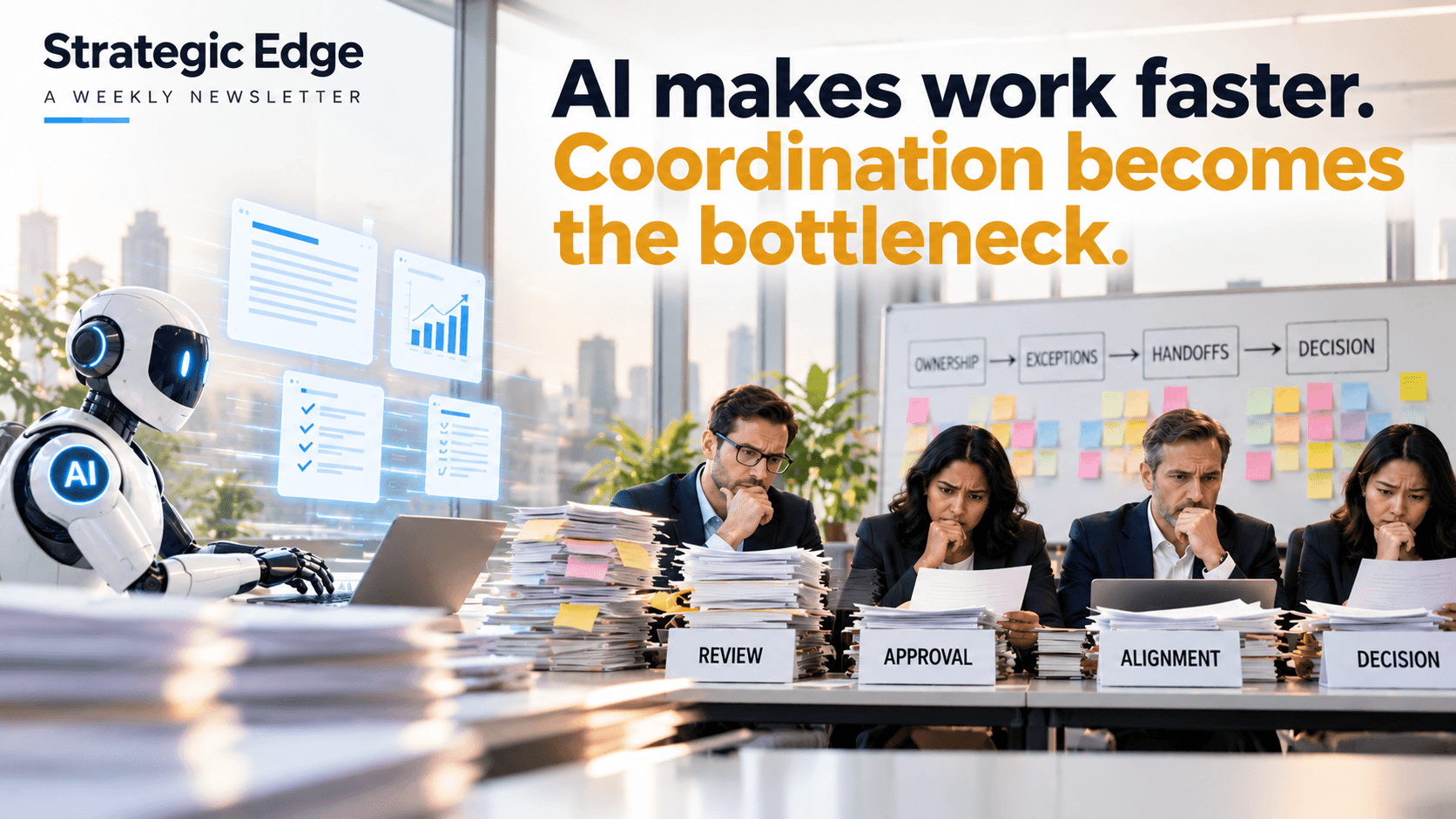
Table of contents
AI is making work faster.
That part is easy to see now.
What is harder to see is what happens after the work gets faster.
Because most companies do not fail when the first draft gets written.
They fail when the decision still has to move through the same approvals, the same handoffs, and the same ownership gaps.
That is where the real bottleneck is shifting.
Not in the task.
In the coordination around the task.
The hidden problem behind faster work
AI is good at compressing effort.
It can draft, summarize, compare, classify, and recommend in seconds.
But most businesses are not actually built around the speed of output.
They are built around people, approvals, and exceptions.
So when AI speeds up the front end of the process, the organization often discovers something uncomfortable:
The work is faster, but the system is not.
The model can create ten options.
Someone still has to choose one.
The model can flag the risk.
Someone still has to own the call.
The model can surface the exception.
Someone still has to decide what happens next.
That is why faster AI does not automatically create better businesses.
It often just exposes the parts of the operating model that were already slow.
The coordination layer is the real constraint
A lot of businesses are trying to improve output without changing how work is actually coordinated.
That creates a pattern leaders recognize quickly:
- More drafts
- More reviews
- More exceptions
- More follow-up
- More decisions waiting for a human owner
In other words, AI makes the work move faster until it reaches the part of the organization that was never redesigned.
Then everything slows down again.
The result is frustrating because the tool is doing its job.
The workflow is not.
That is why the question is no longer, “Can AI do this task?”
The better question is, “What human step is now the bottleneck, and does it still deserve to exist?”
Where this shows up in practice
Ownership
AI can generate a recommendation very quickly.
But if no one owns the final call, the recommendation creates motion without closure.
The output is there.
The decision is not.
Exceptions
Most AI systems work fine on the standard case.
The real test begins when the case is unusual, incomplete, or sensitive.
That is where organizations discover whether they have a workflow or just a stack of tools.
Handoffs
A lot of work gets stuck between teams.
One team creates the draft.
Another team reviews it.
A third team approves it.
A fourth team implements it.
AI can accelerate each step individually and still leave the overall process slow if the handoffs are unclear.
That is the part leaders often underestimate.
What leaders should look for
If AI is already making work faster inside your business, the next question is not whether you should add more AI.
The next question is which part of the workflow should be removed, redesigned, or reassigned.
Before scaling a new AI workflow, I would ask:
- Who owns this decision end to end?
- Which step exists only because the process is slow?
- What happens when the answer is plausible but wrong?
- What is the exception path?
- What decision gets better because this workflow exists?
Those questions matter more than activity metrics.
Because the business does not pay for output.
It pays for better outcomes.
A simple test for your next AI workflow
Take one process in your business and ask a blunt question:
If AI made the first 80 percent of this work three times faster, what would happen to the last 20 percent?
If the answer is:
- It would still wait for the same person.
- It would still sit in the same queue.
- It would still need the same approvals.
- It would still get stuck in the same handoff.
Then the process is not really transformed.
It is just compressed.
And compressed friction is still friction.
Decision of the Week
Before your next AI rollout, ask this in the room:
Which human coordination step is now the bottleneck, and does it still deserve to exist?
If that question does not have a clear answer, you do not have an AI problem.
You have an operating model problem.
And that is where the real strategic edge starts.
The evidence is the advantage.
Thanks for reading Strategic Edge.
Every week, I break down a business event or operating pattern, not just to report it, but to uncover the strategic decision hiding beneath it.
Because in the AI era, faster work is common. Better judgment is not.