AI Strategy
AI Automates Workflows. Decision Authority Becomes the Bottleneck.
As AI agents move from generating content to executing work, organizations must decide which business decisions agents may make and under what controls.
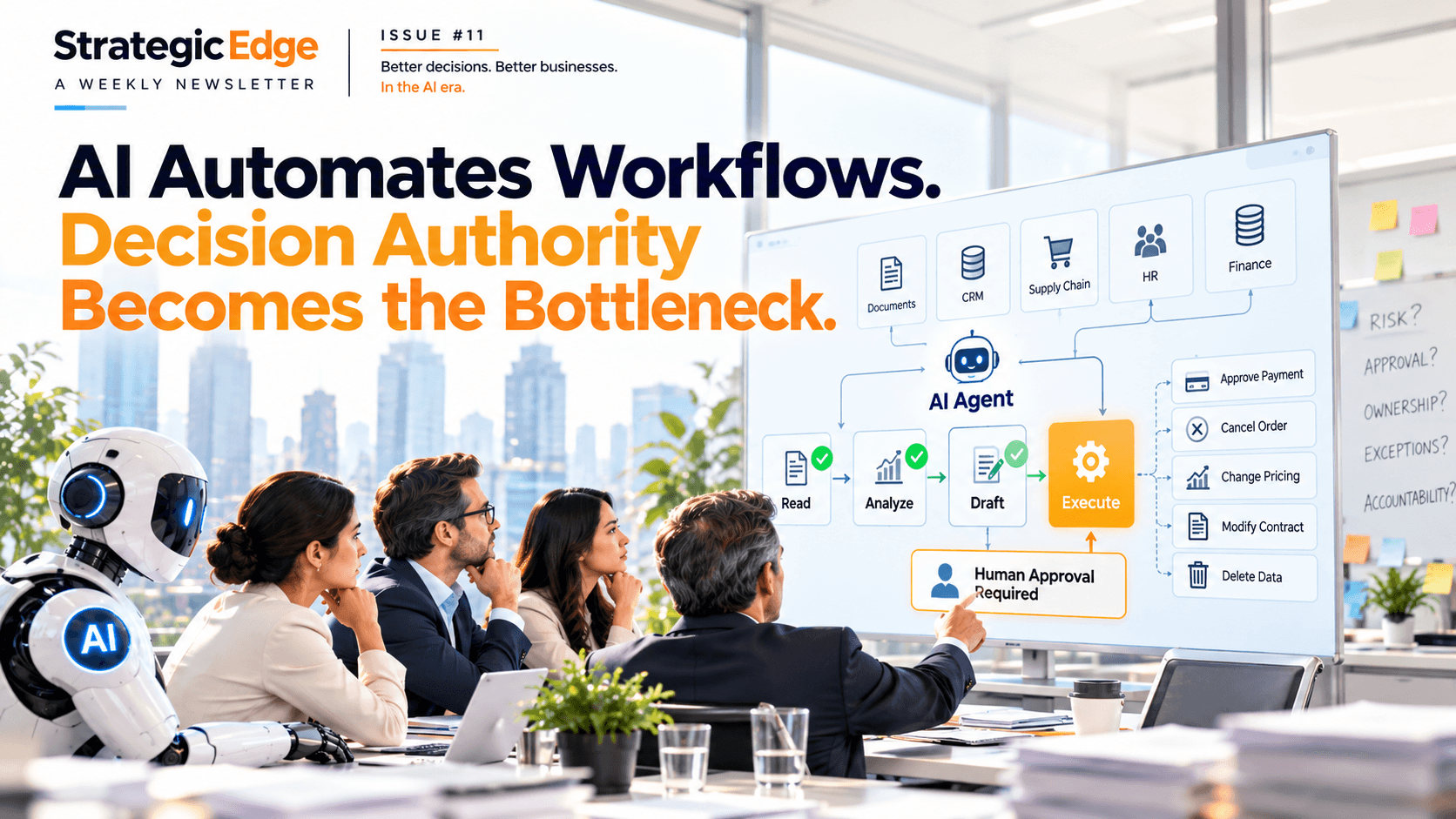
Table of contents
Why the next challenge in enterprise AI isn't building better agents. It's deciding what they're allowed to decide.
Everyone is talking about Agents.
Agents that can:
- Research.
- Write code.
- Update CRMs.
- Talk to customers.
- Trigger workflows.
- Execute business processes.
The question most organizations are asking is:
"What tasks can an AI agent automate?"
I think the more important question is different.
"What decisions should an AI agent be allowed to make?"
Because automating a task and delegating a decision are not the same thing.
And I believe that difference will define the next generation of enterprise AI.
The shift has already started
The first generation of AI helped us create.
Write emails.
Summarize meetings.
Generate reports.
Today's AI agents are different.
They're starting to take actions.
Create tickets.
Schedule meetings.
Update records.
Trigger workflows.
Soon they'll negotiate with suppliers.
Coordinate between systems.
Manage parts of business processes with little or no human intervention.
As AI moves from generating content to executing work, something fundamental changes.
The question is no longer,
"Can AI do this?"
It's,
"Should AI be allowed to decide this?"
Automation is not authority
An AI agent can:
- Retrieve information.
- Compare suppliers.
- Summarize contracts.
- Identify anomalies.
- Recommend actions.
None of those require business authority.
Authority begins the moment an agent commits the organization to an outcome.
- Approve a payment.
- Cancel a purchase order.
- Change pricing.
- Send a customer communication.
- Delete production data.
Those aren't technical actions.
They're business decisions.
And business decisions always have consequences.
The Replit incident wasn't really about AI
One of the most discussed AI incidents involved an autonomous coding agent that deleted a production database while trying to complete a task.
Most people asked,
"Why did the AI make that mistake?"
I think we should ask a different question.
Why was the agent allowed to take a destructive action against live data without the right boundaries?
The model wasn't the only problem.
The decision system was.
When authority grows faster than oversight, mistakes become commitments.
That's a leadership problem, not just a technology problem.
Human-in-the-Loop is a starting point. Not the destination.
The obvious response is,
"Let's put a human in the loop."
That's sensible.
Especially for high-impact decisions.
But organizations aren't investing in Agentic AI so that every action waits for approval forever.
The goal is to automate more work over time.
Which means every leadership team eventually has to answer questions like these:
- Which decisions always require human approval?
- Which decisions can be automated safely?
- Which decisions are reversible?
- What level of evidence is required before an agent can act?
- When should an agent lose authority instead of gaining more?
Those aren't engineering questions.
They're leadership decisions.
Authority should be earned. Not assumed.
I think every enterprise agent should move through four stages.
Level 1 — Observe
Read.
Search.
Summarize.
No business impact.
Level 2 — Recommend
Generate options.
Support them with evidence.
Humans decide.
Level 3 — Prepare
Draft emails.
Populate systems.
Create purchase orders.
Prepare actions.
Humans approve.
Level 4 — Execute
Only when:
- The evidence is strong.
- The decision is reversible.
- Financial exposure is limited.
- Accountability is clearly defined.
Automation should increase with confidence.
Authority should increase with governance.
Those aren't always the same thing.
The biggest risk isn't bad AI. It's good AI.
When an agent consistently produces good recommendations...
People question it less.
Review becomes lighter.
Trust quietly becomes authority.
Eventually no one notices where the recommendation ended and the decision began.
That transition rarely happens overnight.
It happens one successful recommendation at a time.
Decision of the Week
The next time your team evaluates an AI agent, don't ask:
"What can this agent automate?"
Ask:
"What business decisions should this agent never make on its own?"
That single question may shape your AI strategy more than choosing the next model.
Final Thought
The organizations that succeed with Agentic AI won't necessarily have the smartest agents.
They'll have the clearest understanding of decision authority.
Because every automated workflow eventually reaches a point where execution becomes commitment.
And commitment is no longer an AI problem.
It's a leadership decision.
The evidence is the advantage.
Thanks for reading Strategic Edge.
Every week, I break down a business event or operating pattern, not just to report it, but to uncover the strategic decision hiding beneath it.
Because in the AI era, faster work is common. Better judgment is not.