AI Strategy
Leadership Got the AI Rollout Right. Adoption Failed Anyway
Why employee trust, not technology, determines whether an AI rollout becomes real adoption.
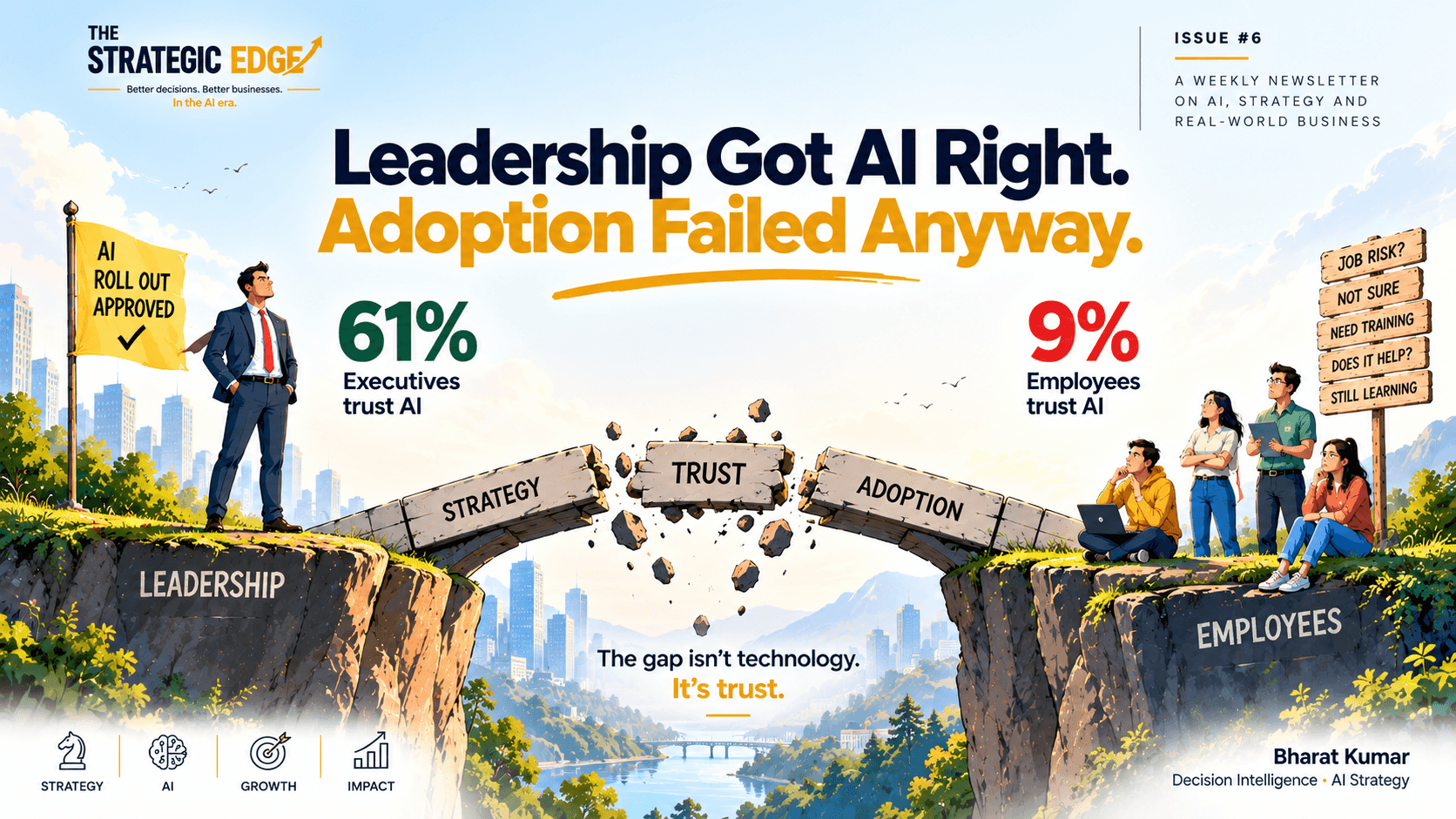
Table of contents
Leadership approved the AI rollout.
Employees quietly ignored it.
Nobody noticed until productivity failed to improve.
The problem wasn't AI. It was trust.
What the numbers actually show
WalkMe surveyed 3,750 executives and employees across 14 countries.
Only 9% of workers trust AI with complex, business-critical decisions.
61% of executives think they do.
That 52-point gap is not a communications problem. It is a decision nobody owns.
Then there is the second number. 88% of executives said employees have adequate tools. Only 21% of workers agreed.
Leaders are not disagreeing with their teams. They do not know there is anything to disagree about.
WalkMe's own CEO, Dan Adika, said it better than any framework could:
"The problem is not AI's capability. What won't improve on its own is the human side."
Glassdoor's 2026 sentiment analysis found the same pattern from a different angle. AI mentions in employee reviews increased 240% between May 2025 and May 2026. Positive sentiment among reviews mentioning AI fell from 81% in 2019 to 43% in 2026. More than half now appear in the "cons" section.
The AIDE Institute analysed over 500,000 employee reviews. Where leadership ambition outpaced execution, 27.5% of AI mentions were negative. Where execution matched the messaging, that fell to 12.6%.
Mercer's 2026 Global Talent Trends report found the number I keep coming back to.
99% of CEOs now expect AI-driven layoffs in next 2 years.
Only 32% of executives believe their organization can integrate human and machine capabilities well.
The leaders most responsible for the AI transition are, by their own admission, not confident they can do the human side of it. That is not a technology gap. That is a trust gap.
Two clocks running at two different speeds
Here is a way to picture what is actually happening.
Leadership moves on one clock. A decision gets made in a room. A budget gets approved. A tool gets procured. All of that can happen in weeks.
The people doing the work move on a completely different clock. Trusting a new tool enough to change a habit they have built over years is not a decision in the same sense. It is closer to a slow, accumulating judgment, formed one small interaction at a time.
Procurement runs on calendar time. Trust runs on experience.
Nobody signs off on that shift in one meeting. It either accumulates or it does not.
The mistake most rollouts make is assuming those two clocks run at the same speed.
They do not.
What this looks like on a Tuesday afternoon
A sales manager is asked to use AI to draft every proposal.
The first one saves him an hour. He is quietly impressed.
The second introduces an embarrassing error. A client catches it. He spends two hours fixing what should have taken thirty minutes.
By Friday, he is using AI officially. He is also rewriting everything privately before it goes out.
The dashboard records adoption. Reality records distrust.
That is how a rollout that looks successful on paper quietly fails where it counts.
Why this keeps happening
1. People don't resist AI. They resist what it implies about their future.
An AI system that can do part of someone's job well is not experienced as neutral. It is experienced as a quiet judgment on how replaceable that part of their work is.
2. AI rarely arrives first. It arrives after years of organizational fatigue.
Most companies rolling out AI have already been through a remote-work shift, at least one reorg, and probably a cloud migration. AI is one more change on a stack people are already tired of absorbing.
3. Mandates create compliance. Trust creates adoption.
A tool can be made mandatory in a memo. Genuine reliance cannot.
When leadership treats the memo as the finish line, people comply on paper and route around the tool wherever they can.
The Leadership Question
What does this tool remove from someone's day?
Not framed as an efficiency memo. Framed honestly, to the people whose daily work is about to change, in terms of what gets easier, not just what gets faster for the company.
If the honest answer inside your organization is "we have not said that part out loud yet," the structural decisions upstream may all be sound, and the rollout can still fail anyway.
Decision of the Week
Before your next AI rollout goes company-wide, ask one question in the room, not about the technology, about the people:
If we required this tool starting tomorrow, would our best people actually rely on it, or simply appear to?
If you do not know the honest answer to that question, you do not yet have an adoption plan. You have a procurement decision, and those are not the same thing.
The Strategic Edge: AI adoption is not a technology problem. It is a human trust problem.
A note on sourcing: WalkMe's State of Digital Adoption 2026 report surveyed 3,750 executives and employees across 14 countries. Glassdoor's data comes from its 2026 AI sentiment analysis. The ambition-versus-execution findings are from the AIDE Institute's analysis of over 500,000 employee reviews. Mercer's Global Talent Trends 2026 report was based on nearly 12,000 responses.
Thanks for reading Issue #6 of Strategic Insights.
Every week, I will break down a real business event, not to report the news, but to uncover the strategic decisions hiding beneath it.
Because in the AI era, technology is becoming abundant. Sound judgment is not.