AI Strategy
McDonald's ran an AI pilot for 3 years, but never defined what success looked like.
Your AI Strategy Has More Vendor Slides Than Decisions
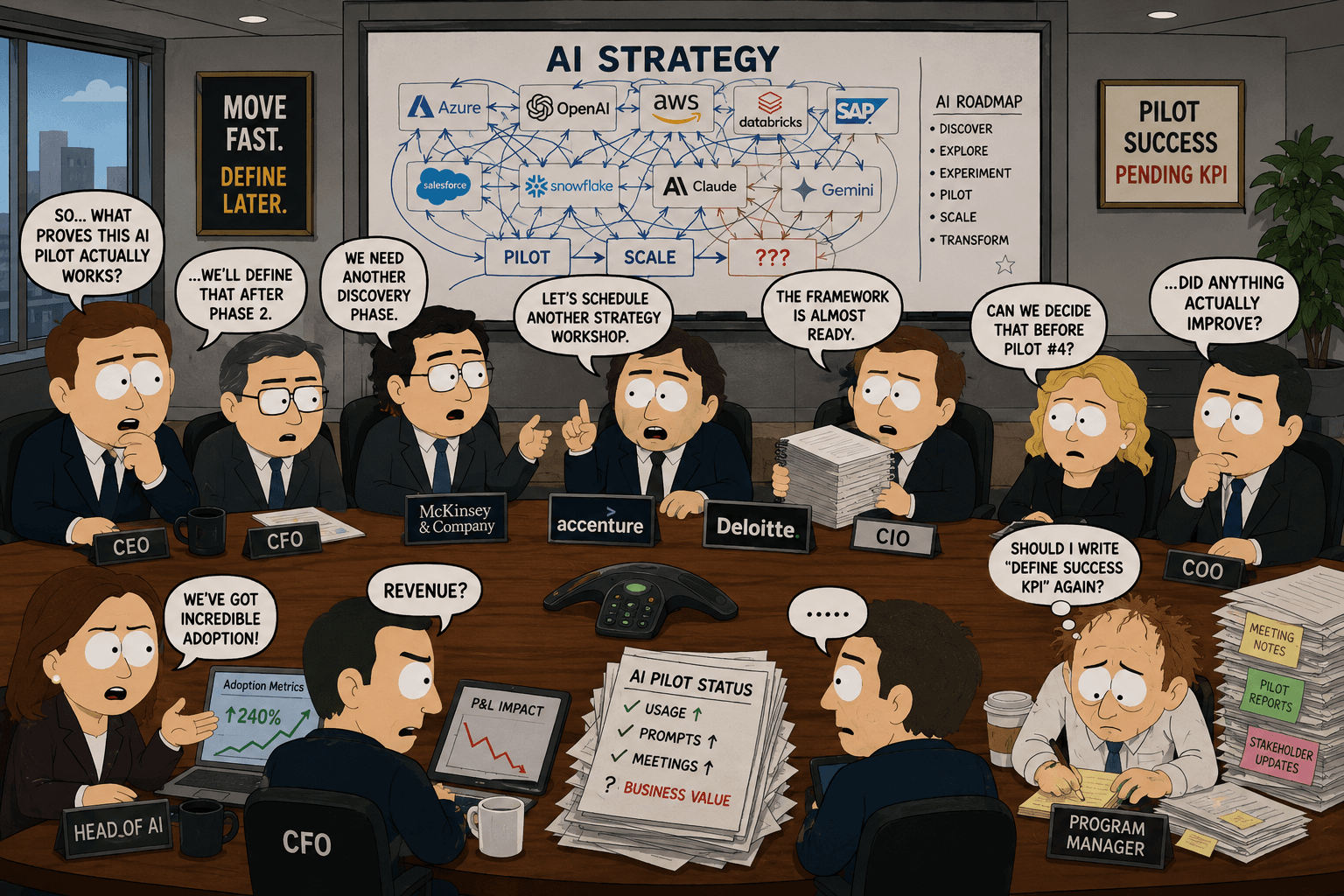
Table of contents
Everyone is talking about AI.
Almost nobody is talking about whether it is actually producing a business outcome.
Open LinkedIn today and you will see endless posts about models, agents, prompts, productivity, and automation. The conversation is full of energy.
And for good reason.
AI is moving fast.
But there is a question hiding underneath all that enthusiasm:
If AI is everywhere, why do so many AI initiatives still look busy without becoming useful?
Most AI strategy documents look impressive.
Vendor logos, slides arranged neatly. Architecture diagrams with confident arrows running in every direction. A roadmap moving left to right - Explore, Scale, Transform - with no dependencies drawn between the stages, because a dependency would mean admitting something has to finish before something else can begin.
What is almost always missing is the thing that actually matters:
A decision.
Not a vendor decision. Not a platform decision. An actual decision about which specific business outcome the whole effort is supposed to move.
I think this is one of the most underdiagnosed reasons AI initiatives stall.
And McDonald's gives us a clean, public example of exactly what that looks like.
A three-year pilot that showed progress, but still ended
McDonald's spent years testing AI-powered voice ordering at its drive-thrus.
The pilot showed progress.
And yet it still ended.
That is the part worth sitting with, because "it showed progress" and "it is ready to scale" are not the same statement.
The gap between those two statements is exactly where most AI initiatives quietly live for years.
They generate enough confidence to keep going.
They never generate enough evidence to move forward.
I have started calling this the Confidence Gap.
It is the space between:
- a pilot that feels like it is working, and
- a pilot that has actually proven, with a number, that it is working.
Almost every stalled AI initiative I come across is sitting somewhere inside that gap.
The missing number
Here is the question too many teams quietly avoid answering before launch:
What number would tell us this is working well enough to scale?
Not a feeling. Not a demo. Not a confident statement in a press release.
A number.
- Order accuracy
- Cost per transaction
- Complaint rate
- Throughput
- Customer satisfaction
- Operational lift
Pick one.
Define it precisely.
Decide, before the pilot ever starts, what threshold counts as success.
Without that, a pilot can keep producing optimism indefinitely without ever producing accountability.
Nobody is lying in that scenario.
They are just measuring the wrong thing - or measuring nothing at all - and calling the resulting good feeling progress.
The slides-not-decisions trap
This is why so many AI strategies look strong on paper and act weak in practice.
A strategy workshop produces broad themes:
- customer experience
- employee productivity
- operational efficiency
- data and insights
- new business models
An architecture diagram appears.
Vendor logos get arranged.
The pilot gets a sponsor.
A governance framework gets drafted.
Somewhere in the middle of all that motion, the one question that actually matters gets quietly postponed:
What exact metric proves this is working?
By the time anyone circles back to it, the vendors are chosen, the budget is approved, and the project has developed a life of its own.
The decision has been replaced by activity.
And activity is much easier to report on in a steering committee than a decision nobody has made yet.
What McDonald's actually needed
The real question was never:
- Which AI vendor is best?
- Can we automate voice ordering?
- How advanced is the model?
- How much can we demo in twelve weeks?
The real question was:
What exact number tells us this belongs in the restaurants of the future?
If that number does not exist before launch, the pilot is already weaker than it looks.
Not because the technology is bad.
Because the decision underneath it was never actually finished.
That is the deeper problem.
Most AI projects do not fail because the model is weak.
They fail because the business decision was incomplete.
Why this keeps happening
After following the experiences of organizations adopting AI at scale, I keep seeing the same three patterns.
1. Technology feels tangible. Value does not.
Choosing between models feels like progress.
Defining success is harder.
So organizations naturally spend more time comparing vendors than agreeing on what should actually change.
2. Activity gets mistaken for progress.
AI creates visible movement almost immediately.
Usage increases. Dashboards light up. Employees become more productive. Leadership feels momentum.
Business outcomes take months to appear.
Sometimes they never do.
Motion is easy to measure.
Value is much harder.
3. Ownership quietly disappears.
IT owns implementation.
Engineering owns adoption.
Finance owns the budget.
Business leaders own outcomes.
When responsibility gets divided this way, something surprising happens.
Everyone owns part of the project.
Nobody owns whether it actually succeeded.
The AI Value Equation
Before approving any AI initiative, I believe leadership teams should answer five questions together.
Not after deployment.
Before it.
1. What business problem are we solving?
Not "Where can we use AI?"
What problem is valuable enough to justify solving?
2. Which business metric must move?
Revenue?
Margin?
Retention?
Cycle time?
Risk?
Pick one.
3. Who owns that metric?
Not the AI team.
A business leader whose performance depends on that specific number.
4. How will we know this worked?
Six months from today -
what evidence would convince us this investment was worthwhile?
5. If AI usage doubles tomorrow...
does business value double too?
If the answer is no...
you are probably measuring adoption rather than impact.
My perspective
Over the next few years, building with AI will become dramatically easier.
- Generating code
- Writing reports
- Creating content
- Launching agents
Those capabilities are rapidly becoming commodities.
Which means the real competitive advantage is shifting somewhere else.
Not into better models.
But into making better decisions.
The organizations that outperform will not necessarily have access to smarter AI.
They will simply become better at asking one question before every investment:
What business outcome are we buying?
Because AI rarely fails because it lacks intelligence.
It fails because organizations never defined, in advance, what success was supposed to look like.
Decision of the Week
Before approving your next AI initiative, ask one question in the room.
If this project succeeds exactly as planned...
Which business metric changes first?
And just as importantly...
Who is personally accountable for proving that it changed?
If nobody has a clear answer, you are probably not funding a business decision.
You are funding an experiment.
And those two things should never be confused.
Thanks for reading Issue #2 of Strategic Insights.
Every week, I will break down a real business event - not to report the news, but to uncover the strategic decisions hiding beneath it.
Because in the AI era, technology is becoming abundant. Sound judgment is not.