Decision Intelligence
Meta Bet Thousands of Jobs on AI. Then the Numbers Came Back Ugly.
Meta Bet Thousands of Jobs on AI. The real failure wasn't the technology.
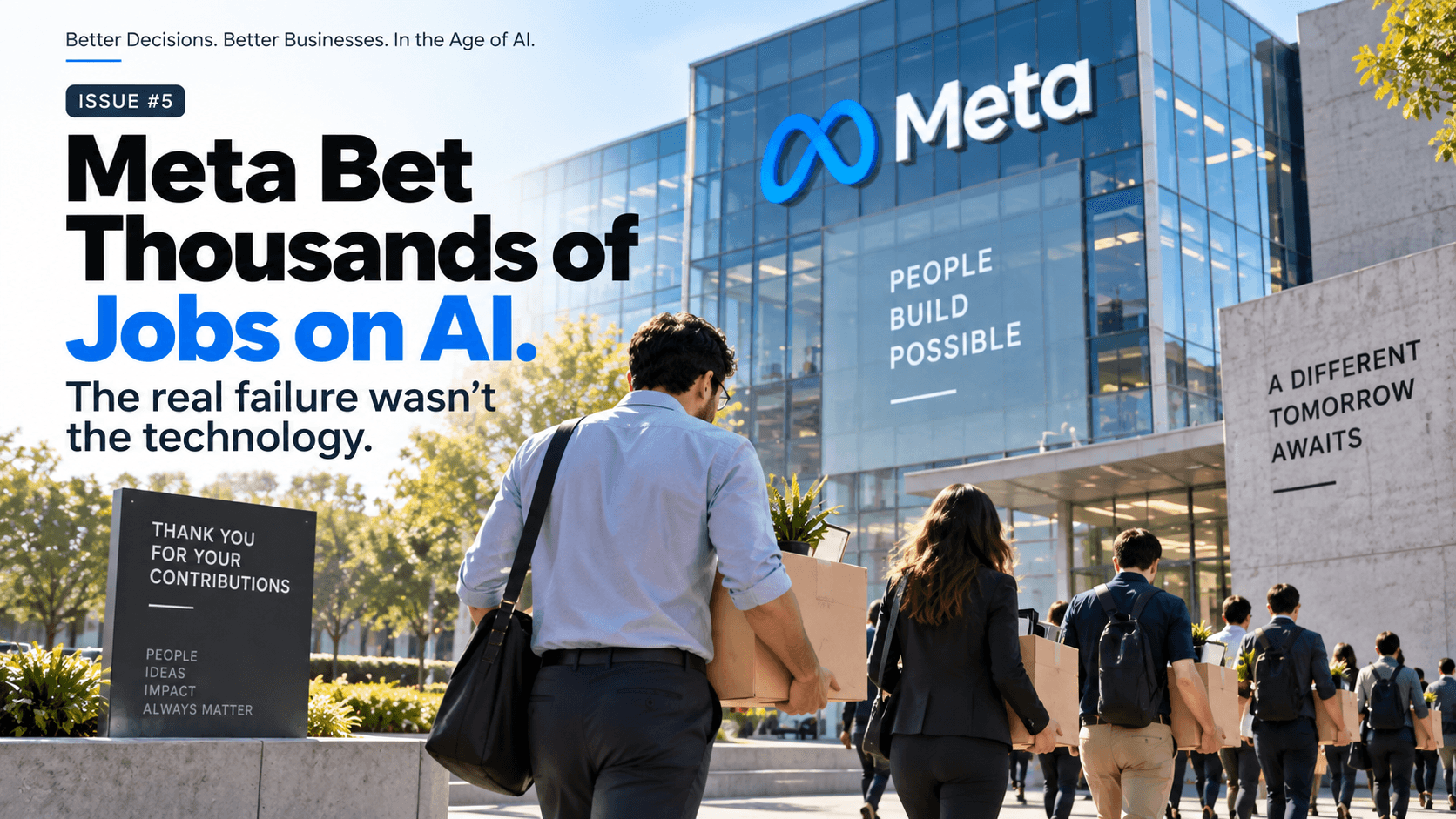
Table of contents
Everyone is talking about how much AI can generate.
Almost nobody is talking about what happens when the generation goes up and the actual value does not.
Meta just gave us one of the most expensive answers yet.
And the details, once you sit with them, are more unsettling than the headline suggests.
It started at a retreat in Hawaii
In January 2026, Mark Zuckerberg gathered his senior leadership at his compound in Hawaii for the company's annual retreat.
There, they sketched out a plan code-named Project OT, short for Organization Transformation.
The vision was an "AI-native" Meta.
AI agents would take over much of the daily work thousands of employees were doing.
Humans would shift from executing to supervising.
Product teams that used to run 10 to 20 specialists would shrink into small pods of three to five generalists.
Layers of middle management would go.
In scenario planning, executives explored cutting some teams by as much as 60%.
The plan came in two waves.
The first in May 2026.
The second in November 2026.
Then came April
That month, Meta told its US employees that their keystrokes, mouse clicks, and screens would be captured.
The purpose was to teach the company's AI models how real people complete real tasks on a computer.
There was no opt out on a corporate laptop.
Think about what that means for a moment.
Thousands of people were being asked to train the very system their employer was evaluating as their replacement.
Quietly.
Without being able to say no.
More than a thousand employees signed a petition against it.
Internal satisfaction scores, measured in Meta's twice yearly Pulse survey, fell from 74% to 55%.
These are not numbers on a spreadsheet.
They are people who had spent years building something, now watching the ground shift under them.
The night the plan quietly died
On the night of May 19, hours before the first round of layoffs was set to begin, Zuckerberg called off planning for the November cuts.
Reuters could not determine exactly what triggered the reversal.
But the timing is hard to ignore.
The next morning, Meta went ahead anyway.
Roughly 8,000 people, about 10% of its staff, lost their jobs.
Thousands of open roles were closed.
More than 7,000 employees were moved into AI related work.
The second wave never came.
What the numbers actually showed
The verified figures are hard enough on their own.
Internally, employees flagged that unchecked AI agents were performing what they described as large scale, disruptive actions that humans would be unlikely to execute.
Major technical and security incidents, things like service disruptions and possible data leaks, rose 40% year over year.
The time staff had to spend firefighting those incidents rose by as much as 70%.
Code changes to internal platforms were up 220% year over year, according to a June post from Meta's CTO.
But changes that led to new or upgraded features actually reaching users were up only 36%.
That leaves a gap of nearly 184 points between what was produced and what shipped.
By July, Zuckerberg told staff at an internal town hall that the trajectory of agentic development over the previous four months had not accelerated the way the company expected.
The bets on the new structure, he said, had not come to fruition yet.
"We're talking about AI agent technology," he said. "It hasn't progressed as fast as I anticipated."
Meta has published no savings figure from the restructuring.
What it has disclosed is 1.18 billion dollars in severance costs for the quarter.
The gap nobody measured
Here is the part that matters most.
Meta did not fail because AI could not generate output.
It failed because nobody had clearly defined, before the restructuring began, what "more" was actually supposed to mean.
More code, or more value delivered to users.
Those turned out to be very different things.
One analyst put it plainly:
Meta trusted a forecast of AI capability before it existed in production. Meta booked a forecast as capacity.
That is not a technology failure.
It is a judgment failure.
The same one this newsletter has traced through four other companies over the past month.
Only this time, the stakes were real jobs.
Thousands of them, based on a bet about AI capability that the company's own leadership now admits did not hold up in time.
This was not just Meta's problem
Zuckerberg reportedly now has a "CEO agent" helping him retrieve information faster without going through layers of staff.
The company was confident enough in AI agents to restructure thousands of roles around them.
It was not confident enough to let the second wave of cuts go through.
That gap between what leadership said publicly and what it did internally is the same gap showing up in organizations everywhere.
Why this keeps happening
The same three patterns from earlier issues.
Only this time, with human jobs on the line.
1. Output feels tangible. Outcomes do not.
More code, more agents running, more visible activity.
All of it is easy to point to as proof that something is working.
Whether it ships, whether it is used, whether it is better than what it replaced, that takes longer to measure and is far less exciting to report upward.
Meta's CTO celebrated a 220% increase in code changes.
Nobody asked what happened to the features.
2. Activity gets mistaken for productivity.
AI agents running around the clock looks like productivity.
But security incidents rising 40% and staff time lost to handling them rising 70% suggests the activity was real and the productivity gain was, at best, partly an illusion.
The agents were not idle.
They were creating work.
3. Ownership quietly disappears.
Someone owned the restructuring plan.
Someone owned the AI rollout.
Someone owned the layoff execution.
But the specific judgment call, whether AI output volume was a valid proxy for AI value, does not appear to have had a clear owner before thousands of people had already lost their jobs on the bet that it was.
The AI Value Equation, extended for workforce replacement
The five questions from earlier issues still apply.
When AI is used to justify replacing human roles, one more question becomes non-negotiable, and it may be the most important one this newsletter has posed yet.
Who verifies that AI output actually creates value before people lose their jobs because of it?
Not leadership, in general.
A specific, named person, accountable for confirming with real evidence, not projected output, that the AI can actually do what the restructuring assumes it can.
Before the restructuring happens.
Not after.
If the honest answer inside your organization is some version of "nobody, exactly, but we are confident it will work," then you are not executing a workforce strategy.
You are running the most consequential kind of experiment there is.
And you will find out the results after the people are already gone.
Decision of the Week
Before your next AI driven restructuring, ask one question in the room, out loud, before a single role is eliminated.
If this does not work the way we are assuming, how would we know? And how much would already be irreversible by the time we found out?
One of the most sophisticated technology companies in the world ran this exact experiment at scale, in public, and had to reverse course on its second wave before it went out.
Meta could afford this experiment.
Most organizations cannot.
And most will not find out until after the second wave would have gone out.
Thanks for reading Issue #5 of Strategic Insights.
Every week, I will break down a real business event, not to report the news, but to uncover the strategic decisions hiding beneath it.
Because in the AI era, technology is becoming abundant. Sound judgment is not.